
Silt Sock Submittal Package
Now Offering: SILT SOCK
What is Silt Sock?
Silt Sock is an erosion control BMP that has many
applications and uses. With the ability to slow water flow
and filter sediment that has mixed with storm waters and
natural flows on disturbed lands until final stabilization has
been achieved.
What is the benefit of Silt Sock vs Silt Fence?
Silt sock creates a barrier that is far superior in strength and
filtering capacity when compared to Silt Fence to prevent
a breach of perimeter control devices during times of high
flow making clean up and reestablishment less costly over
the life of the project.
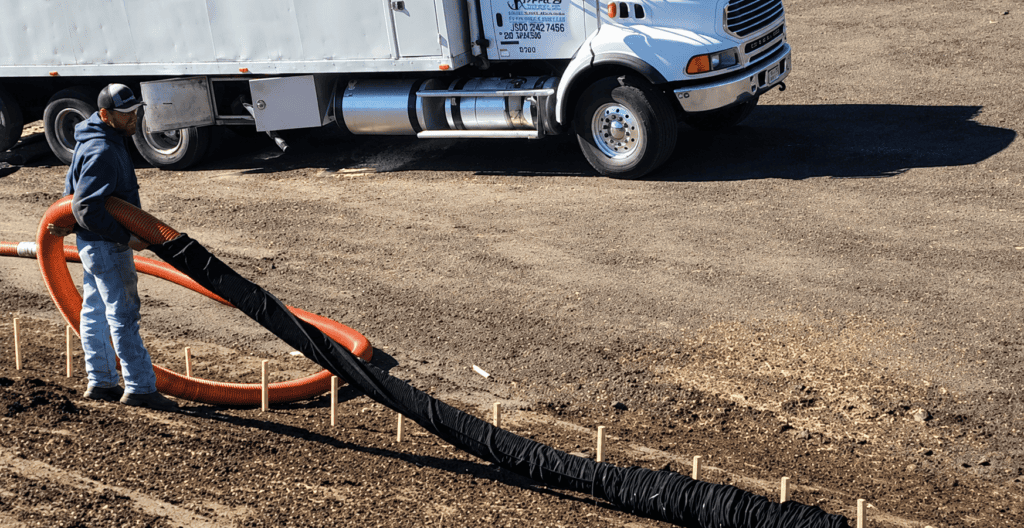
With the ability to both utilize our blower trucks to create
280+ foot continual logs on site as well as palletized
logs prefilled and delivered to your site for installation
by traditional means. We also after a variety of sizes and
lengths to fit your specific project conditions
What sizes are available?
Silt Sock is available in 24”,18”,12” and 8”.
NO Trenching is Required
That’s right, the need for all that trenching is not needed as silt socks are a filtering device, not a
damming device, with increased filtration and porosity to move water more quickly and cleanly off
the disturbed site and into waterways – as clean uncontaminated water.
Silt Socks Maintenance and Disposal
- One of the largest benefits Silt Socks offers is the reduction in maintenance and replacement.
- Perimeter control failures are reduced, lowering the cost of cleaning sidewalks streets and gutters after a failure.
- Additional logs can be added in needed areas to fortify the level of control.
Silt Socks are a game changer when comparing to traditional silt fence for disposal.
- You can simply cut the biodegradable sock and scatter the organic compost wood chips right on site, amending the soil and providing organic matter to fortify existing soils.
- This reduces waste significantly and makes job sites more sustainable.

Description
A compost filter sock is a type of contained compost filter
berm. The filter sock is typically a mesh tube filled with
composted material that is placed perpendicular to the
direction of sheet flow to control erosion and retain
sediment in disturbed areas. A compost filter sock has
an oval or round cross-section and provides a three dimensional filter to retain sediment and other pollutants
(e.g., suspended solids, nutrients, metals and motor oil)
and allow clean water to flow through (Faucette et al.,
2009). The filter sock can replace a traditional erosion
and sediment control practice, such as a silt fence or
straw bale barrier, and is often more effective. The
composts in filter socks come from a variety of
feedstocks, including yard trimmings, food residuals,
separated municipal solid waste, biosolids and manure.
Construction staff generally place compost filter socks
along the perimeter of a site or at intervals along a slope
to capture and treat sheet flow. They can also serve as
storm drain inlet protection on pavement. They are
flexible, and construction staff can fill them in place or fill
and move them into position, making compost filter
socks especially useful on steep or rocky slopes where
installation of other erosion and sediment control
practices is not feasible. Compost filter socks have more
surface area contact with the underlying soil than typical
sediment control devices, so stormwater is less likely to
create rills under them and/or create channels carrying
unfiltered sediment. The greater contact area and weight
of compost filter socks also allows water to pond
upgradient and suspended sediments to settle out.
Applicability
Compost filter socks apply to construction sites or other
disturbed areas where stormwater discharge occurs as
sheet flow. Compost filter socks can apply to steeper
slopes with faster flows if they have closer spacing, lie
beside and/or on top of each other, have larger
diameters, or work in combination with other stormwater
controls such as compost blankets.
It is also important to account for regional considerations
such as ambient temperature and moisture conditions.
Freezing temperatures and prolonged dry periods can
impact the compost’s effectiveness and life span
(USACE, 2008).
Compost filter socks can be vegetated or unvegetated.
Vegetated filter socks can remain in place to provide
long-term stormwater filtration as a post-construction
stormwater control measure. The vegetation grows into
the slope, further anchoring the filter sock. Construction
staff often cut open unvegetated filter socks upon project
completion, and they spread the compost around the site
as soil amendment or mulch. They then dispose of the
mesh sock unless it is biodegradable.
Maturity: Maturity indicates how well the compost will
support plant growth. One maturity test compares the
percentage of seeds that germinate in compost
compared to a potting soil mix. The difference in
germination rates marks the maturity of the compost.
Stability: Stability indicates microbial activity in the
compost and can directly correlate to carbon dioxide
production from the compost due to microbe respiration
during the decay process. A stable compost has no
offensive odors, does not resemble the original material
and has low rates of carbon dioxide off-gassing.
Absence of pathogens: The pathogen count indicates
how sanitary the compost is. In 40 CFR, Part 503, EPA
has defined processes for composting that reduce the
number of pathogenic organisms to nondetectable levels
and ensure the resulting compost is sufficiently heat treated and sanitary.
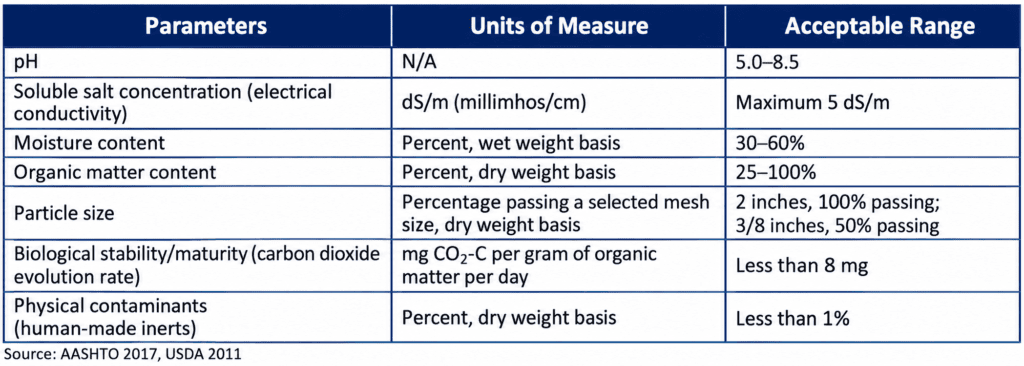
The compost in filter socks should meet all local, state
and federal quality requirements and meet the guidelines
outlined in Table 1. All compost should comply with 40
CFR, Part 503, which establishes safe standards for
pathogen reduction and presence of heavy metals.
The U.S. Composting Council (USCC) certifies compost
products under its Seal of Testing Assurance Program.
Compost producers whose products the Seal of Testing
Assurance Program has certified provide customers with
a standard product label that allows comparison among
compost products. The USCC website contains
information on the current Seal of Testing Assurance
Program requirements and testing methods.
Construction staff should choose a mature, biologically
stable compost that meets the particle size specifications
in Table 1 above. This ensures that the nutrients in the
composted material are in organic form, less soluble and
less likely to migrate into receiving waters.
The American Association of State Highway
Transportation Officials (AASHTO) and many individual
state departments of transportation have issued
specifications for filter socks (AASHTO, 2017; USCC,
2001). These specifications describe the quality and
particle size distribution of compost for compost filter
socks for highway construction projects. Research on
these parameters continues to evolve; therefore, design
engineers should contact the department of
transportation or state environmental agency where they
will install the filter sock to obtain any applicable
specifications or compost-testing recommendations.
Compost filter socks can apply to many types of
construction projects and various landscaping projects
as well. Construction staff may modify these parameters
depending on local site conditions or needs, as
appropriate.
Siting and Design Considerations
Filter sock assembly involves tying a knot in one end of
the mesh sock, filling the sock with the composted
material (usually using a pneumatic blower), then
knotting the other end once the sock reaches the desired
length. A filter sock is normally the width of the slope to
ensure that stormwater does not break through at the
intersection of socks placed end to end. Where this is
not possible, construction staff place the socks end to
end along a slope and interlock the ends.
The diameter of the filter sock varies depending on the
purpose of the filter sock, as well as the steepness and
length of the slope. Construction staff usually place
compost filter socks along a contour perpendicular to
sheet flow. In areas of concentrated flow, compost filter
socks often serve as check dams. Local rainfall and
appropriate storm scenarios should determine the sizing
and spacing of filter socks. Specifications manuals can
provide detailed information regarding diameter, length,
specific location and spacing recommendations for filter
socks (e.g., USDA 2011 and ASSHTO 2017).
Studies examining the use of erosion and sediment
control practices utilizing compost in bioretention
systems, compost blankets and as soil amendments
have shown both reductions in organic nutrients and
releases of nutrients (N and P) in leachate and infiltrate.
The potential for nutrient discharges from erosion and
sediment control practices that utilize compost should be
considered to determine whether compost use is
appropriate especially in cases where there are
receiving waterbodies that are sensitive to or are
currently impaired by nutrients. Site conditions, compost
type and composition, compost berm placement and
management of the compost system also will affect
potential nutrient loadings or reductions and pollutant
loadings to receiving waters. The use of this practice
should be considered weighing the overall efficacy of the
system in terms initial nutrient loadings, mid-life nutrient
trapping capacity and the potential for end-of-life nutrient
discharges where nutrients are of concern.
Installation
The advantage of compost filter socks over similar
stormwater controls is that they do not require trenching;
therefore, installing them does not disturb the soil.
However, construction staff should trim or remove
vegetation and debris to ensure full contact with the
silt fences without a reduction in sediment removal
efficiencies (Keener et al., 2007). A U.S. Department of
Agriculture study found that compost filter socks reduced
clay and silt particulates (the major contributors to
suspended solids and turbidity) by 65 percent,
outperforming straw bales and mulch berms. The same
study saw a reduction in bacteria of 75 percent,
reduction in heavy metals of 37 to 71 percent and
reduction in petroleum hydrocarbons of 43 to 84 percent
(Faucette et al., 2009). In a similar study, compost filter
socks reduced phosphorus concentrations by about 60
percent, compared to removal rates of around 20
percent by silt fences (Faucette et al., 2008).
ground surface. Once staff have filled the filter sock and
placed it, they should anchor it to the slope. The
preferred anchoring method is to drive stakes at regular
intervals through the center of the sock at least 8 inches
into the ground (USDA, 2011); alternatively, construction
staff can place stakes on the downstream side of the
sock. They should direct the ends of the filter sock
upslope to prevent stormwater from running around
them. Incorporating seed into the compost before
placement in the filter sock can vegetate the filter sock.
Since it is not necessary to trench compost filter socks
into the ground, construction staff can install them on
frozen ground or even cement.
Limitations
Construction staff can install compost filter socks on any
type of soil surface; however, they should cut down or
remove heavy vegetation to ensure that the compost
contacts the ground surface. Stormwater and sediment
control devices, including filter socks, are not appropriate
for use in streams.
Maintenance Considerations
Construction staff should inspect compost filter socks
regularly, including after each rainfall event, to ensure
proper function. Excessive upstream ponding or
overtopping indicates that the current configuration is not
adequate. In these cases, construction staff should place
an additional filter sock further up the slope or use an
additional erosion control, such as a compost blanket, in
conjunction with the filter sock. Staff should remove
accumulated sediment when it reaches one half the
height of the filter sock or as the current EPA
Construction General Permit or equivalent state and
local permits mandate. If the compost filter sock is a
temporary application, at the end of the project,
construction staff can spread the compost material in
areas that do not receive concentrated flow (USDA,
2011).
Effectiveness
A number of studies have shown that compost filter
socks are at least as effective as traditional erosion
controls at removing settleable solids, total suspended
solids and a variety of other pollutants from stormwater.
An Ohio State University study found that compost filter
socks have a 50 percent higher flow-through rate than
Cost Considerations
The cost to install a compost filter sock depends on the
availability of the required quality of compost in an area.
The cost for a biodegradable compost filter sock
generally ranges from $5 to $10 per linear foot, with the
cost mostly dependent on the cost of the compost
(RSMeans, 2019). Although costs for fully biodegradable
netting can be more than non-biodegradable netting, the
labor cost savings from not having to remove the control
measure—as well as the subsequent benefit to soil
condition and vegetation establishment—may justify this
cost. However, there is still the cost to remove and
dispose of sediment that accumulates to at least one third the distance between the top of the fiber roll and
the ground surface.

References
American Association of State Highway Transportation Officials (AASHTO). (2017). Standard specifications for
transportation materials and methods of sampling and testing designation R 51-13 compost for erosion/sediment control
(filter berms and filter socks).
Brown, S., Corfman, A., Mendrey, K., Kurtz, K., and Grothkopp, F. (2016). “Stormwater Bioretention Systems: Testing the
Phosphorus Saturation Index and Compost Feedstocks as Predictive Tools for System Performance.” Journal of
Environmental Quality, 45(1), 98–106.
Confesor Jr, R. B., Hamlett, J. M., Shannon, R. D., and Graves, R. E. (2009). “Potential Pollutants from Farm, Food and
Yard Waste Composts at Differing Ages: Leaching Potential of Nutrients Under Column Experiments. Part II.” Compost
Science & Utilization, 17(1), 6–17.
Eck, B., Barrett, M., McFarland, A., Hauck, L., Mcfarland, A., and Hauck, L. (2010). “Hydrologic and Water Quality
Aspects of Using a Compost/Mulch Blend for Erosion Control.” Journal of Irrigation and Drainage Engineering-ASCE,
136(9), 646–655.
Faucette, B. (2010). “Nature’s Way.” Public Works Magazine.
Faucette, B., Cardoso-Gendreau, F., Codling, E., Sadeghi, A., Pachepsky, Y., & Shelton, D. (2009). Stormwater pollutant
removal performance of compost filter socks. Journal of Environmental Quality, 38, 1233–1239.
Faucette, B., Cardoso-Gendreau, F., Codling, E., Sadeghi, A., Pachepsky, Y., & Shelton, D. (2009). Stormwater pollutant
removal performance of compost filter socks. Journal of Environmental Quality, 38, 1233–1239.
Faucette, L. B., Sefton, K. A., Sadeghi, A. M., & Rowland, R. A. (2008). Sediment and phosphorus removal from
simulated storm runoff with compost filter socks and silt fence. Journal of Soil and Water Conservation, 63(4), 257–264.
Keener, H., Faucette, B., & Klingman, M. (2007). Flowthrough rates and evaluation of solids separation of compost filter
socks vs. silt fence in sediment control applications. Journal of Environmental Quality, 36(3), 742–752.
RSMeans. (2019). Erosion and Sedimentation Controls [Online data file]. RSMeans data from Gordian.
U.S. Army Corps of Engineers (USACE). (2008). Filter socks technology. Engineer Research and Development Center.
U.S. Composting Council (USCC). (2001). Compost use on state highway applications
U.S. Department of Agriculture (USDA). (2011). Agronomy technical note no. 4.